
Геологические детерминанты затрат на добычу нефти: сравнительный анализ экономики производства в основных нефтедобывающих странах (2015-2025)
Товар


3 006 ₽
Геологические детерминанты затрат на добычу нефти: сравнительный анализ экономики производства в основных нефтедобывающих странах (2015-2025)
- 0 раз купили
- 0 оценка
- 30 осталось
- 0 отзывов
Доставка
Характеристики
Артикул
B0GRP71TH6
Identyfikator produktu
B0GRP71TH6
Język
Angielski
Wymiary
15.24 x 2.08 x 22.86 cm
Data publikacji
7 marca 2026
Długość wersji drukowanej
364 str.
Описание
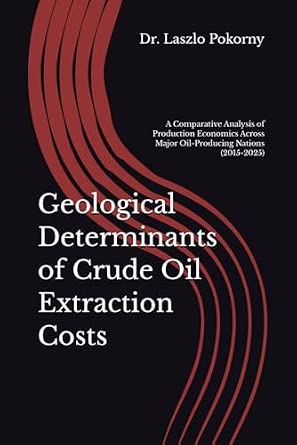
The global petroleum industry, a cornerstone of modern civilization and a primary engine of economic growth, is characterized by an inherent and often overlooked variability in the cost of producing its central commodity: crude oil. This variability is not an incidental market fluctuation; rather, it is a fundamental determinant of competitive advantage, geopolitical influence, and strategic decision-making. Understanding the "unseen calculus of crude"—the complex interplay of geological endowments, technological sophistication, operational scale, and environmental considerations that dictate extraction expenses—is therefore crucial for anyone seeking to comprehend the dynamics of global energy markets, resource allocation, and international relations.This book delves into the critical question: What truly determines the cost of extracting crude oil from the earth, and how do these determinants translate into quantifiable differences across major producing nations? We posit that beyond the immediate market price, the underlying economics of production are shaped by specific, measurable factors. These include the physical properties of the oil reservoirs themselves—such as API gravity and sulfur content—which dictate the ease with which oil can be extracted and processed. Furthermore, the nature of the reserves, differentiating between conventional and the increasingly prevalent unconventional sources like shale oil and oil sands, presents distinct technological challenges and cost structures. The sheer scale of production also plays a pivotal role, engendering economies of scale that can significantly lower per-barrel expenses.Our research focuses on seven of the world's most significant oil producers: the United States, Venezuela, Russia, Iran, Saudi Arabia, Iraq, and Canada. This selection provides a diverse sample, encompassing a wide spectrum of geological settings, technological approaches, political regimes, and production scales. By analyzing data spanning the period from 2015 to 2025, we aim to capture the recent evolution of extraction costs, particularly in light of transformative technologies and market shifts such as the U.S. shale revolution and the global push towards energy transition.Employing rigorous panel data econometric methods, this study quantifies the relationships between key geological and technical factors and extraction costs, distinguishing between immediate "lifting costs" and more comprehensive "full-cycle costs." We specifically investigate the significant cost premium associated with unconventional production, quantifying its impact on both metrics. The objectives are manifold: to contribute to the theoretical understanding of resource economics, to provide practical insights for energy security strategies, to inform the assessment of economic sanctions, and to guide planning for the global energy transition. This book seeks to move beyond descriptive analysis to offer a data-driven, quantitative understanding of the forces that shape the economics of oil extraction, providing a vital resource for academics, industry professionals, and policymakers alike.
Гарантии
Гарантии
Мы работаем по договору оферты и предоставляем все необходимые документы.
Возврат товара
Безопасная оплата
Банковской картой, электронными деньгами, наличными в офисе или на расчётный счёт.
Отзывы о товаре
